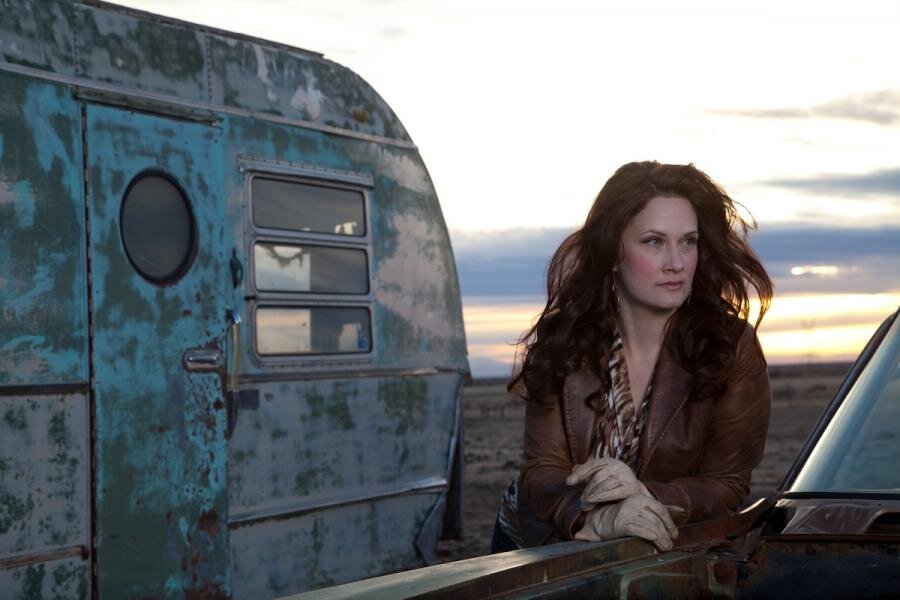
Amy Rigby Remembers Personal, Musical Wilderness in "Girl to Country"


Amy Rigby, by Bert Eke
Nashville didn’t work out as planned for the acclaimed singer/songwriter who emerged as part of the community orbiting Maxwell’s in Hoboken.
Amy Rigby’s musical high water mark came in 1996 when she released Diary of a Mod Housewife. In The Village Voice, Robert Christgau gave it an A and called it “Concept album of the year.”
It finished number eight in the Voice’s year-end Pazz and Jop poll behind Beck’s Odelay, The Fugees’ The Score and DJ Shadow’s Endtroducing …, and ahead of Tricky’s Pre-Millennium Tension and Pulp’s Different Class.
On the album, Rigby told stories of love, romance and relationships among bohemians growing through their thirties in New York City, and she did so with remarkable touch. The songs are fun, often funny, but she never treats herself or the people in them like jokes. She’s at the age and in a world where she has learned to temper her expectations, but she can still hope.
The songs reveal a life that’s not storybook, but she’s perceptive enough to recognize low-key moments of love and grace when they’re there. Diary of a Mod Housewife comes from real life without feeling confessional. Rigby doesn’t treat the listener like her therapist or someone she can unload on. Instead, the album plays as a genuine moment of sharing, a hand extended to others trying to figure out what comes next.
Since then, Rigby has recorded 13 albums include three with her husband Wreckless Eric, and the quality of the singing and songwriting has never dipped. Levels of success, unfortunately, have—the music business being what it is. Her second memoir, Girl to Country shows her dealing with those ups and downs.
Amy Rigby will read from Girl to Country and perform at NOLA ‘Nacular on Thursday night.
Her first book, Girl to City, tells the story of Rigby moving to New York City and the life leading up to Diary of a Mod Housewife. Girl to Country recounts Rigby’s years in the personal and professional wilderness. Some relationships worked and one was really didn’t, while her career became something even she had to question. She’s like many of her peers who started their musical lives as part of the American underground in the late ’80s. The promising, insurgent quality once associated with their music was muted by time, which left Rigby and a lot of artists like her in a professional No Man’s Land. What’s left of the music industry always searches for new twentysomethings, and the audiences that once turned up at shows reliably had families and careers that made it hard for them to get out like they used to.
The artists spent their skill-acquiring years making acclaimed music that always looked to be on the verge of something bigger, but that something rarely happened. In greater or lesser degrees, they have dealt with the same existential questions that Rigby gives us a window into in the book.
Much of Girl to Country is set in the landing place for all songwriters with an eye for domesticity: Nashville. There, musical friends convinced her that Nashville needed her, and they were right. Unfortunately, “need” and “want” are very different things, and while country music would be better with more writers like Rigby, the country music industry is allergic to the nuance and intelligence that make writers like her stand out. She made the music that the other Nashville songwriters admired, but it took a long time for her to realize that the current industry is built on songs so direct, clear, and literal that Rigby looks like Robyn Hitchcock in contrast.
Still, Rigby stays in motion throughout Girl to Country, chasing a musical life even while asking herself why. She works to balance it with earning a living and being a divorced mother of a teenage girl, and one of the strengths of the book is the way Rigby presents all this with measured clarity. She may have felt dizzy at times trying to juggle competing demands on her time, but we’re not dizzy following her. As a narrator, she never lets us get too far ahead of the woman on the page. Even when we as readers see what’s happening before Amy in Nashville does, we’re not so far ahead that we become impatient.
That’s important when Rigby becomes involved in an emotionally abusive relationship. It’s hard to read, but here too Rigby’s deft touch helps. It’s a part of her life that could be harrowing to read, and it’s easy to imagine that many of the nights and conversations she glosses over in a line were brutal and painful to live through.
It’s also easy to see how her own insecurities about her career and future left Rigby vulnerable to the manipulations that allowed him to isolate her and control her, and she owns the way some of her choices worked against leaving him, even when she knew she had to.
Still, the ending of the book seems sweeter because she went through that relationship. After it, Rigby gets her happy ending when she finally begins a relationship with British punk era star Wreckless Eric. His presence drifts through the book, as much as talisman as an actual person. If this were a novel, his ephemeral appearances throughout the book would invite us to think about how reckless she might be too. When he finally becomes a real part of her actual life, you can’t help but root for them.
One thing that is clear by the end of Girl to Country is that the twin tracks the memoir seems to follow—the personal and the professional—are really one, certainly for Rigby and probably most musicians. Rigby writes about her contentious relationship with her father who didn’t understand her choices, and even though she doesn’t spell this out when recounting arguments, she’s an artist. The question was never What are you going to do with your life? even if that’s what he kept asking. The better question would have been, What are you going to do when it doesn’t pay?
Girl to Country shows Rigby doing what most people do with that question: Keep moving, keep working, and see what happens.
Creator of My Spilt Milk and its spin-off Christmas music website and podcast, TwelveSongsOfChristmas.com.