BTE's Kevin Griffin Gets in the AI Game with Soundbreak
Does AI controlled by artists really help anybody but those artists?
In May, this piece ran in Antigravity, where My Spilt Milk has a monthly column. Thanks to Antigravity for the space, the commitment to indie culture, and the help with this piece.
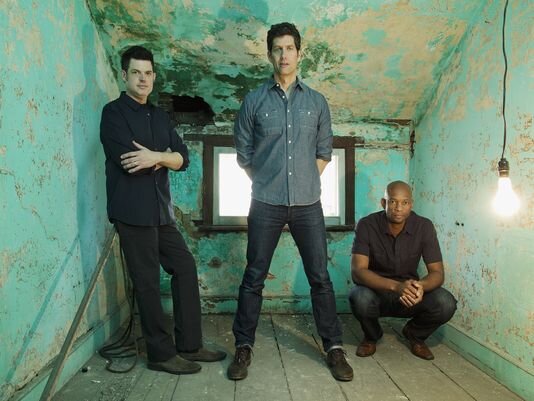
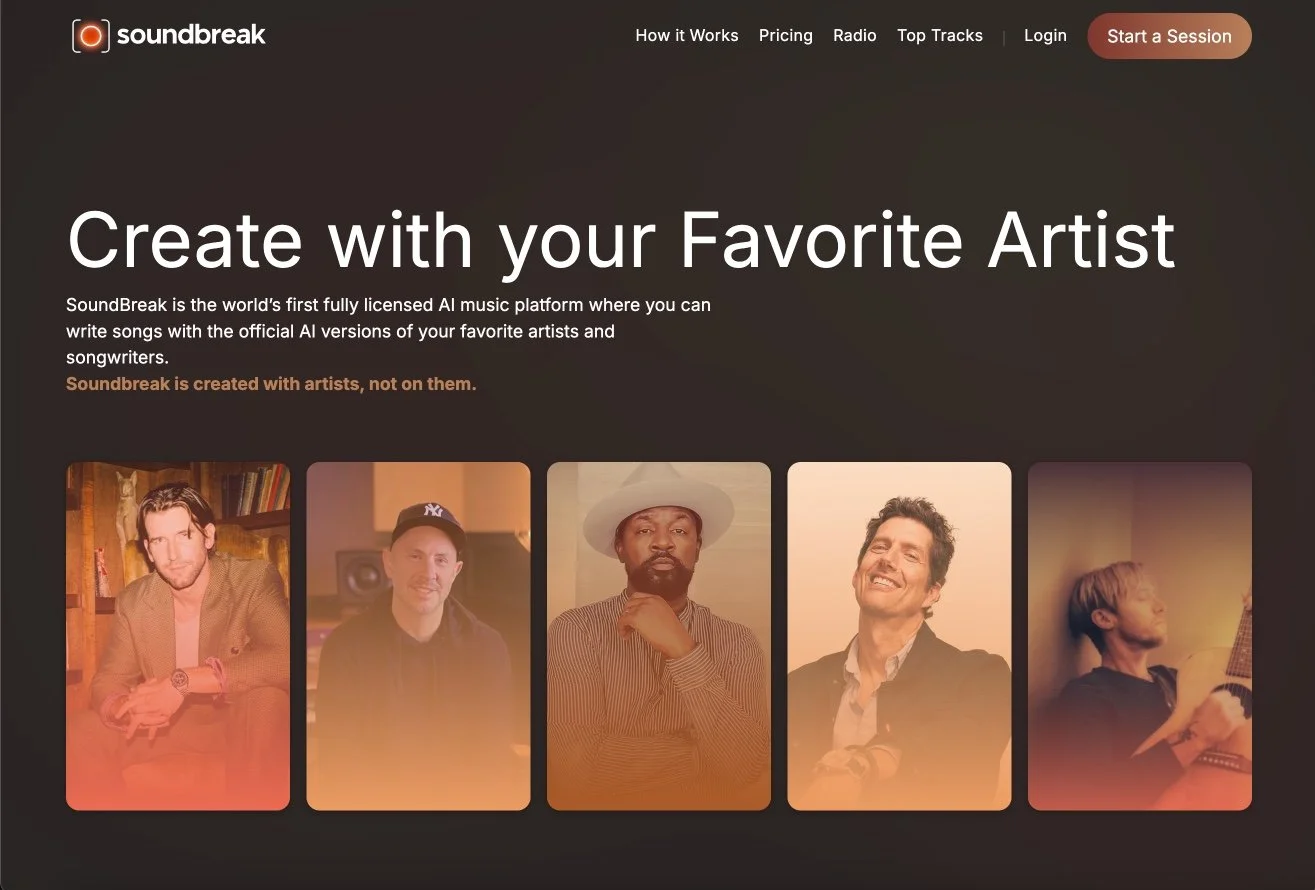
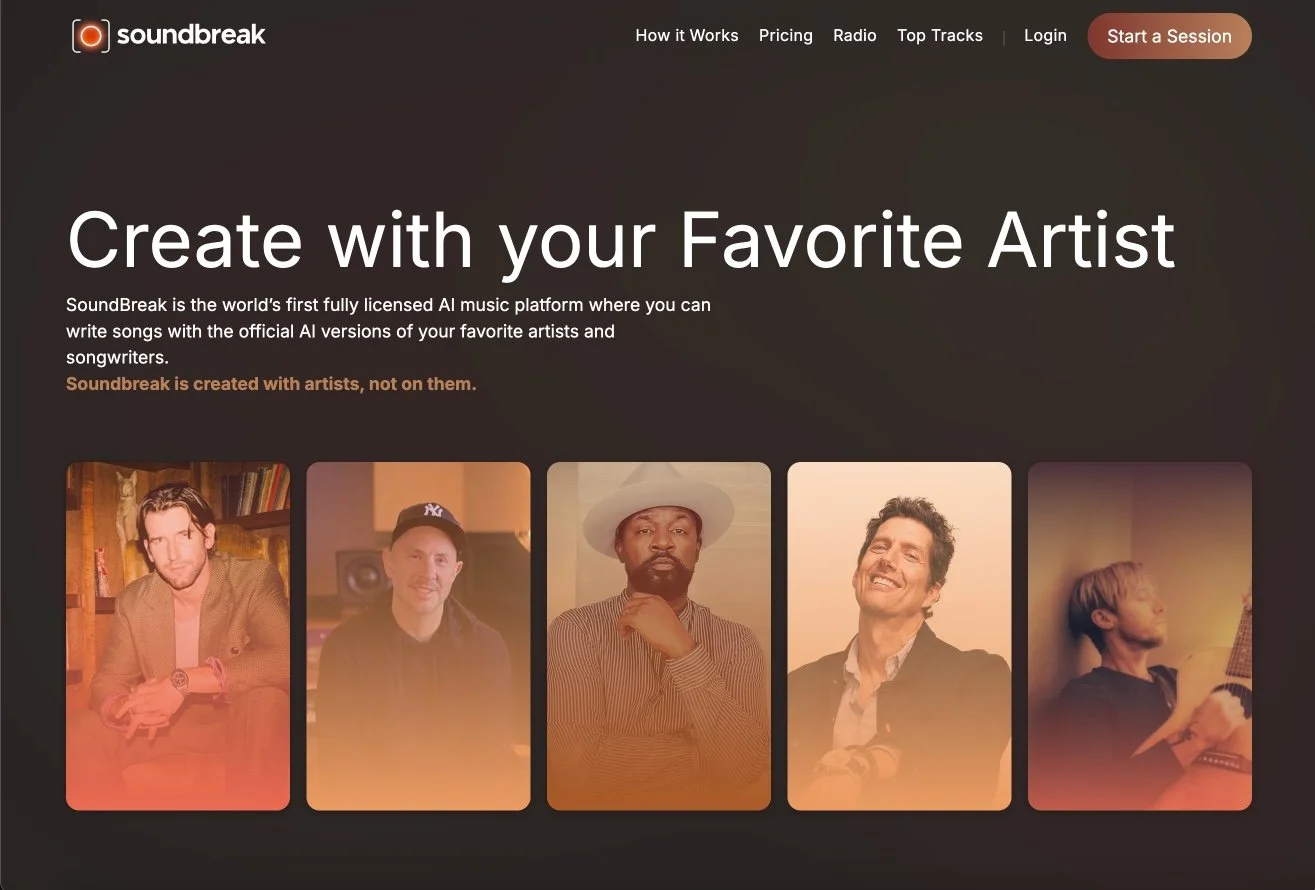
In February, Kevin Griffin of Better Than Ezra announced the creation of Soundbreak, an AI site that allows aspiring songwriters and artists to “collaborate” with individualized AI libraries trained on the works of Griffin, bandmate Tom Drummond, Jaren Johnston of The Cadillac Three, Michael Fitzpatrick of Fitz and The Tantrums, David Ryan Harris, Sam Hollander, Lincoln Parish, Max Frost, Wes Bailey, Shane Sniteman, InkogNito, and “indie rock newcomer” Blind & Oblivious. Only one woman is pictured among the possible collaborators, Khara Lord, but she is identified as Vinyl Pinups, the electronic duo she’s one half of along with Brennen Aerts.
The premise of Soundbreak is that “you can write songs with the official AI versions of your favorite artists and songwriters. Soundbreak is created with artists, not on them.” “Favorite” might be generous, but Griffin presents Soundbreak as the ethical AI, one that makes sure that artists get paid for AI-related work based on their creative input. “In an exploding industry where songwriters and artists are being left out of the AI conversation, we’re setting a new standard—one where technology amplifies creativity and artists get paid for their unique intellectual property,” Griffin said. “This is AI made by artists, for artists.”
This may sound like salesmanship, but it tracks. Better Than Ezra emerged from the ‘80s and ‘90s alternative rock era, but its instincts have never been anarchic. They made smart choices more often than cool choices, and Griffin has also been working as a professional songwriter in the commercial, hit record marketplace for decades. He has been writing for other artists since 2003, when he contributed songs to Blondie, Howie Day, and Meat Loaf. He works in a world that accepts marketplace values as sacrosanct. Neither Griffin nor anyone else at Soundbreak is trying to sell songs through Bandcamp or monetize a fandom on SoundCloud. They’re aiming for checks with numerous zeroes at the end.
To help draw attention to Soundbreak, Griffin announced on social media that fans of Better Than Ezra could use Soundbreak to write the band’s next single. All they have to do is go to Soundbreak and “write with” him or Drummond, but that’s not strictly accurate. The platform has the image of a writers’ room where the collaboration theoretically takes place, but it’s an artificial space where aspiring writers meet and work with the AI Griffin or the AI Drummond. Real life Griffin and Drummond will choose the winning song and record it.
One petty concern about Soundbreak is that it’s hard to look at the list of creators and see an AI that promises great songs. The “collaborators” have written hits including some number ones, but it’s hard to imagine that those songs are anybody’s favorites. You hear Sugarland’s “Stuck Like Glue” or Howie Day’s “Collide”—two of Griffin’s number ones—and you hear good songcraft more than a great song. The AI based on Griffin’s work or the work of other writers on the site will almost certainly respond in ways that steer collaborations in logical directions, which means the songs are unlikely to surprise.
If the results posted on Soundbreak’s Top Tracks page are any indication, the collaborations lean hard toward clichés, with such song titles as “Rescue Me,” “Aint That Hard,” “Cant Shake This Feeling,” “Is It Real?” and “See You Again.” Some of that tired language may come from the user, but the AI didn’t coach them away from such banalities or bad punctuation.
The AI doesn’t lead users to write BTE songs or songs you’ll remember based on what’s on the site. But like a lot of AI, Soundbreak does help writers be competent. For many, that’s progress.
In some cases, the AI will be impoverished. Blind & Oblivious (the name for Barn Sweetman’s one-man project) only has one five-song EP released in 2021 on Apple Music and Spotify with nothing on Bandcamp or SoundCloud. If that really is the limit of his output, then an AI trained by his music would be very generic and almost indistinguishable from other songwriting AI.
In the comments on Griffin’s Instagram announcement of the contest, Sweetman responded to a skeptic, writing, “We’ve got a ton of people really enjoying it and it’s creating a great way for artists to engage with fans.” He’s right and wrong. For the remaining fans of Better Than Ezra, Fitz and The Tantrums, and the bands associated with the other songwriters, Soundbreak is a way to feel more connected with them, but they shouldn’t over-read the experience. The musicians aren’t actually interacting with their fans at all since it’s the AI in the writers’ room.
The defense that Soundbreak is a way to engage fans would mean more if it came from Griffin, responding the way people do in a conversation. That’s not what happened, though. After he announced the contest on Instagram, he disappeared, and when people questioned AI and its environmental impact, Sweetman, not Griffin, responded to fans’ comments. That didn’t go well as he dismissed climate change and claims about water bankruptcy before announcing, “You can have your cake and eat it too.”
The promise of engagement would also mean more if Griffin responded to one guy’s Instagram post of a song written with Soundbreak by saying more than “Great chorus.”
The one place where the artists do actually get involved is the credit. Users of the site share songwriting credit with the artist whose AI collaborated with them. The user gets 50 percent of the credit and any remuneration, while the artist and Soundbreak get 25 percent each. In most cases, the artist and Soundbreak will get a combined 50 percent of nothing since many songs are made using the royalty-free agreement that limits where and how a song can be shared, but if songs actually accrue any royalties, the Soundbreak artist will share in the revenue without doing any actual contemporaneous work on the song.
“AI isn’t going anywhere,” Griffin said on Instagram. “In fact, it’s only going to get better. I can either put my head in the sand or try to figure out what I am going to do about it.” All of that is probably true, but it’s hard to see a boutique AI model that does the same thing as other AIs—one that, really, is asking to be paid a second time for songs written years ago—as a meaningful improvement.

Creator of My Spilt Milk and its spin-off Christmas music website and podcast, TwelveSongsOfChristmas.com.