"Civil Disobedience" Drops at an Unfortunately Appropriate Time
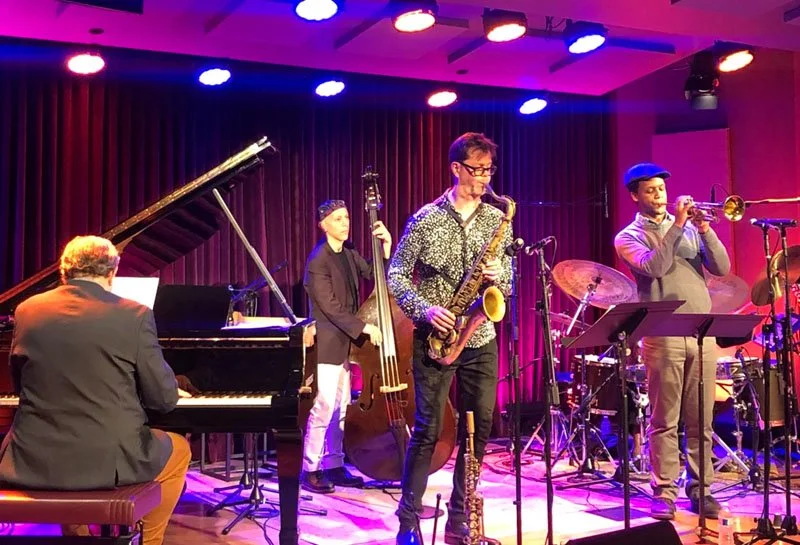
Civil Disobedience playing songs from “Civil Disobedience”
The new jazz album revisits Blue Note Records at a time when it was a progressive voice in the Civil Rights Movement.
David Ambrosio’s Civil Disobedience arrives at the right time. The current administration has created a context that calls for resistance in every form, and since jazz refuses to speak the linear, efficient, market-friendly language of pop and rock, it’s part of the soundtrack of fighting back. Civil Disobedience is out now, and its sound and story make it one more valuable response to the efforts to institutionalize oppression.
Civil Disobedience is officially the name of the band that bassist David Ambrosio formed (with Donny McCaslin on saxophone, Ingrid Jensen on trumpet, Bruce Barth on piano, and Victor Lewis on drums) as well as the title of their debut album. They came together after a student of Ambrosio’s discovered a body of music recorded for Blue Note Records that languished unheard in vaults while the company moved under and away from a few corporate umbrellas in the years that followed.
The freshness Ambrosio heard in the recordings, as well as their origins in the 1960s inspired him to form the band. Some of the songs drew direct inspiration from the Civil Rights Movement including “A Time to Go,” a song intended as a tribute to Dr. Martlin Luther King Jr. recorded by vibes master Bobby Hutcherson in 1968, and “Poor People’s March,” a composition by saxophonist Harold Land intended to serve as a soundtrack to King’s Poor People’s Campaign in 1968.
Today, Blue Note-era jazz may not sound confrontational, but in its moment jazz confounded the dominant culture. The musical values expressed on albums by jazz greats Art Blakey, Clifford Brown, Don Cherry, Donald Byrd, Ornette Coleman, John Coltrane, Miles Davis, Eric Dolphy, Herbie Hancock, Thelonius Monk and countless others emerged from the Black experience in America, and in the performances you heard the sound of African Americans speaking primarily to other African Americans.
Civil Disobedience honors that aspect of the music. The performances demonstrate the band’s obvious affection and respect for Blue Note as an aesthetic statement and collection of influential artists. In the video that lays out the background for the project, Jensen talks about her admiration for Hutcherson, who wrote two of the songs performed on Civil Disobedience.
“To say, Oh, this is 1967 is almost an insult,” she said. “This is timeless music.”
That respect and belief mean that the players approached these compositions as if they were written last month in reaction to 2025, without a hint of deconstruction or reconsideration of the source material. The performances are committed and emotional in recognizable ways.
For that reason, Civil Disobedience may not land as an act of confrontation or resistance. Time, familiarity, and hip-hop samples have siphoned off some of the edge once associated with Blue Note. It’s the sound in the ears of a lot of people when they say the word “jazz,” and other jazz artists have pushed the envelope in directions that seem more challenging now.
In 2026, this project also arrives with an undercurrent of nostalgia for a time when it was easier for people to believe in the nobility and efficacy of civil disobedience, and we hadn’t seen the nakedly corrupt, self-serving lengths people in power would go make sure that the system still served them and their favorites. That’s no reflection on the music or the progressive impulses behind it, but it means that it requires a little historical consciousness to fully appreciate the project’s activist undercurrent.
Civil Disobedience gained relevance when shortly before its release, the Supreme Court essentially gutted what remains of the Voting Rights Act, one of the political products of the Civil Rights Movement that inspired many of the songs on the album. Now, southern states can and are redrawing voting districts to eliminate political representation by people of color, which reminds those of us who might have thought otherwise that no part of the fight for Civil Rights is in the past.
This is a moment that calls for an everything-and approach to defending democracy. Civil Disobedience helps connect the fight then and now.
Creator of My Spilt Milk and its spin-off Christmas music website and podcast, TwelveSongsOfChristmas.com.